
Bring the meters you have
We'll tell you honestly what we can read.
Solar and shared roofs
Split rooftop solar between units every half‑hour, under the rule your owners choose. See import, export and self-use on every meter. And get a warning when a solar meter's export drops well below its recent average.
A 30‑minute video call with the founder. Bring your inverter and export-meter details.
Import, export and self-use on every meter.
Export-drop alerts, and export where no solar is registered.
Where relays are fitted, a diverter runs geysers and pumps on surplus solar.
Shared solar split by your owners' rule, and credited on each bill.
What the labels mean
Built and tested. We're choosing our first pilot sites.See what's built
Bill and collect
Every half‑hour, rooftop solar is split between units under the rule your owners choose. You can see the same month under every rule before you decide. Missing data holds solar back instead of favouring anyone, and a finalised month can't change.
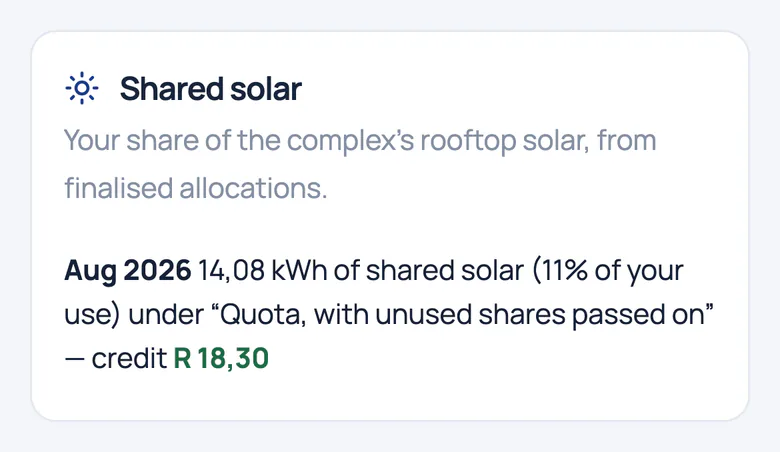
By quota, in proportion to use, equal shares, or quota with unused shares passed on. Exact to the watt-hour.
Each unit's share appears as a credit, valued at the tariff it saved or at the scheme's transfer price.
Once a trustee finalises the month, residents see their credit, and the split can't be changed later.
See everything
Import, export and self-use are kept apart on every meter, and export is never assumed to be a credit. Where a feed-in tariff applies, export is credited on its own line, never netted against import.
Every chart carries an export channel beside import, per meter and per site.
A warning when a solar meter's export falls well below its recent average, and a flag when a meter exports with no solar on record.
Solar, grid and battery figures with the owner's own access. It reads, never writes, and it isn't switched on yet.
Control what matters
When export stays above a threshold, the solar diverter switches on opted-in loads, such as geysers and pool pumps, one by one. Test it on last month's data first.
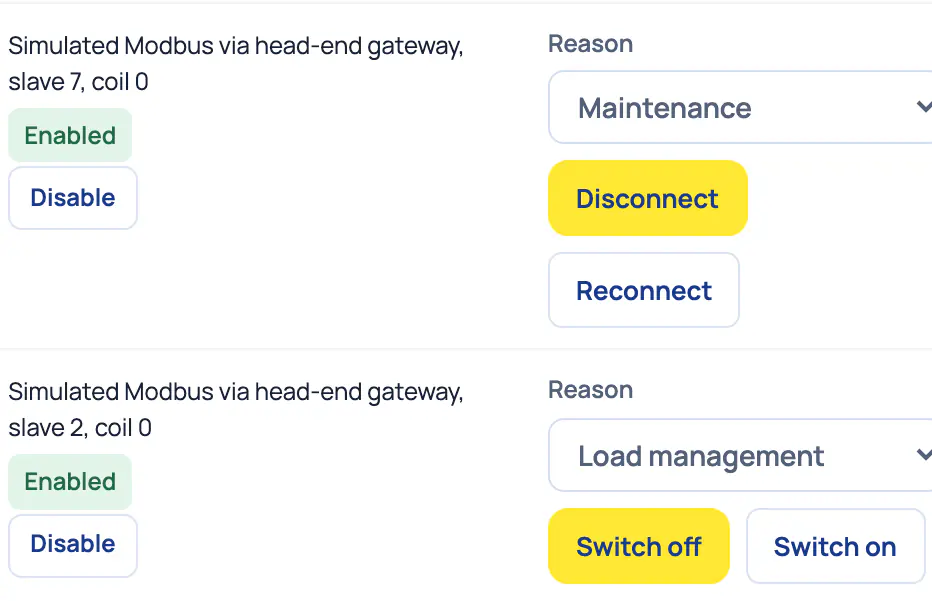
Minimum on and off times protect the loads, and a backtest shows the kWh it would have diverted.
Real hardware starts switched off until a manager enables it, with a fresh confirmation.
In preparation
Other inverters, the performance ratio, PPA billing and hour-by-hour green certificates are designed, not built. If you run PPAs, tell us what you need, and we'll send one message when it's ready.
For PPA providers and their buyers: invoices both sides can check against the same meter data.
A day with Utilitize
What the platform does on its own, and where your trustees decide. The diverter runs on simulated devices until real relays are bench-tested.
Every half‑hour
Each half‑hour's solar is split between units under your rule. A unit with missing data has its share held back, not guessed.
Midday
Where relays are fitted, the diverter switches on opted-in geysers and pumps one by one while export stays high.
Every switch
Each command counts as done only when the meter confirms it.
Next morning
If yesterday's export fell well below its recent average, you get a warning. It can mean a tripped inverter, or simply a busy day at home.
Month-end
A trustee finalises the month. Each unit's solar credit appears on its bill, and the finalised month stays as it is.
On site
What solar sharing and the alerts need. We set up the sharing scheme with you.
A meter we can read on the solar supply
An inverter app isn't a revenue meter. We may add our own meter beside the inverter's.
Smart meters on every unit
Each unit's half‑hours decide its share.
A sharing rule your owners agree
Often at the AGM. We show the same month under every rule first.
Your inverter and export-meter details
Make, model and how export is metered today.
A relay per diverted loadOptional
For the solar diverter: geysers or pool pumps.
We'll tell you honestly what we can read.
Questions
Not yet. A connector for one inverter make's cloud is built but not switched on; other inverters and the performance ratio are in preparation. Today we watch export on the meter: a warning when it drops well below its recent average can mean a tripped inverter.
That's your owners' decision, often at the AGM. Utilitize shows the same month under all four rules first, so everyone sees the difference before the vote.
Its share is held back for those half‑hours instead of being guessed, so nobody gains from a gap. Once the month is finalised, it can't change.
An inverter app shows what the roof made. It doesn't split it between units or put it on bills. Utilitize works from meters, which is what bills are based on.
Not yet: PPA billing is in preparation. Talk to us about PPA billing, and we'll send one message when it's ready.
Bring your inverter and export-meter details.