
Recovery check
Did your complex recover what the municipality billed?
Start with the municipal bill for your bulk supply and subtract what homes were billed and what common property carried. What's left beyond normal losses (6% for electricity, 4% for water) is unexplained: money your complex paid and can't account for.
A quick municipal bill reconciliation for trustees, managing agents and landlords with a bulk supply. We don't keep the figures you enter.
Your result · Electricity
Above normal losses
R2 580 a month unexplained
About R30 960 a year
- Municipal bill
- R32 000
- Billed to homes
- R26 000
- Common property
- R1 500
- Normal losses (6%)
- R1 920
- Unexplained
- R2 580
R4 500 (14,1%) of your bill wasn't recovered. Up to R1 920 may be normal losses. R2 580 is unexplained: about R30 960 a year. Whether any of it can be recovered only shows after about 30 days of 30-minute data from your bulk and unit meters.
Utilitize compares the bulk meter with the unit meters every half-hour and shows where the loss is.
Needs a check meter. Tuned on simulated data.
Before you rely on it
This compares the figures you enter. It can't tell you why money is missing, and it doesn't prove wrongdoing or a fault. Some difference between the bulk meter and the homes is normal (cable losses, meter tolerances, reading dates). The check allows 6% for electricity and 4% for water unless you change it. Utilitize can't promise to recover any amount. Not legal or financial advice.
Catch problems early
Find where the gap opens
A monthly total shows that money is missing, not where. Half-hourly data from every meter does.
When energy or water goes missing between the bulk meter and the units, we show where, since when and how sure we are. Then someone checks on site.
It needs a check meter on the bulk supply and smart meters on the units that report every half-hour.
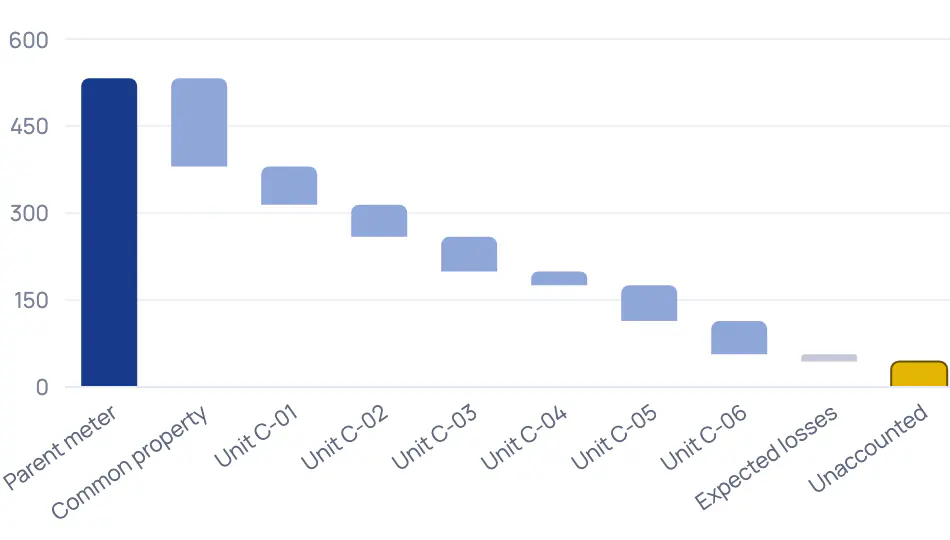
Needs a check meter. Tuned on simulated data.
- Where the energy went. The bulk meter's reading, then common property, units C‑01 to C‑06 and expected losses. The yellow bar is what's left unaccounted.
- Checked against a learned band. Each half‑hour's unaccounted energy is compared with the loss band learned from this site's own history.
- Why we think this. Plain-language reasoning: unit C‑04 started registering far less than its usual pattern at the same time, which explains most of the extra loss.
- Inspection before accusation. The finding stays a probability, with its confidence shown, and asks for a physical inspection before anyone is accused of anything.
What the labels mean
- Ready for pilots
- Built and tested. Ready for our first pilot sites.
- Built · goes live with …
- Built and tested on a sandbox or simulator. Goes live once the partner, hardware or service it names is in place.
- In preparation
- Designed, not built yet. No date until we commit to one.
Built and tested. We're choosing our first pilot sites.See what's built
How we worked this out
How the check works
Simple arithmetic on one month's bills. Here's every step.
The gap
Municipal bill, minus what homes were billed, minus common property.
Its share
The gap divided by the municipal bill.
Normal losses
6% of the bill for electricity or 4% for water, unless you set another figure from 0 to 15%.
Unexplained
Whatever's left of the gap above the allowance. A year is twelve times one month.
Quantity check
Optional: the bulk meter minus the homes' meters added up, in kWh or kL.
- Where the defaults come from
- The 6% and 4% are the generic loss band Utilitize's balance check starts from, before it has learned a site from its own data. They're a design assumption, not market data. Checked 1 Oct 2026.
- Rounding
- Amounts are rounded to the nearest rand before the check runs, so every figure adds up.
- What it can't see
- Tariffs, reading dates and vacant units. Any of them can open a gap.
Questions trustees ask
Before you run it
Which figures do I need?
Three from the same month: the municipal bill for the bulk account, what homes were billed, and what common property cost the scheme. Use amounts including VAT throughout.
What counts as common property?
Electricity or water the scheme uses itself and doesn't bill to a home: common lights, lifts, gate motors and pumps, or water for gardens, the pool and common taps.
Why allow 6% for electricity and 4% for water?
Some difference between the bulk meter and the homes is normal: cable losses, meter tolerances and readings taken on different days. Utilitize's balance check starts from 6% for electricity and 4% for water until it has learned a site's own pattern. The allowance is a design assumption, not market data, so change it if you have a better figure.
We're on prepaid. What do I enter for homes?
What homes bought in the same month. Purchases and use don't line up exactly from month to month, so compare a few months before reading much into one.
Homes were billed more than the bill. Is that a problem?
This check looks for money that goes missing, so it doesn't assess over-recovery. Whether each home was billed the right amount depends on the tariffs used, which this check doesn't see.
Can the check tell us where the money goes?
No. A monthly total shows that money is missing, not where. Comparing the bulk meter with each home's meter every half‑hour shows when the gap opens and which meters move with it. That needs about 30 days of 30‑minute data.
Do you keep the figures I enter?
No. We don't keep what you enter. If you share a link, it carries only the figures in the form.
Updated
Find where it goes. Book a 30-minute walkthrough.
Bring last month's bulk bill.